
🌱 Navigating Uncertainty: 3 Key Points to Remind Your Clients
No matter what the Maga vision is, sustainability still makes business sense.

Hey there,
The topic on everyone’s mind, no matter where you’re located, is how recent shifts in politics might impact climate and sustainability. And while the headlines may focus on the reversals of progress, businesses must remember that sustainability is not just a moral imperative - it makes undeniable economic sense.
If you’re an accountant or advisor with clients concerned about what the future means for their business, here are 3 important points to remind them why sustainability still matters.
1. Sustainability Drives Revenue Growth
Cutting emissions isn’t just good for the planet; it’s smart business. Jesper Brodin, CEO of Ingka Group (IKEA Retail), recently shared their focus to reduce emissions in supply chains and operations helped focused their attention on resources and costs, which in turn lead to revenue growth by 30.9% since 2016 while lowering carbon emissions by 24.3%.
As he says, “Being resource-smart is cost-smart, is business-smart."
It’s a prime example of how focusing on resource efficiency and cost optimisation can strengthen both the bottom line and long-term resilience.
2. Climate Leadership Remains Steadfast
Even as policies shift, businesses and states continue to lead. Following the recent developments, 24 US states reaffirmed their commitment to the Paris Agreement’s goals, 10,000 companies have now set targets and commitment with SBTi, and just two days ago the BBC published it’s Net Zero Transition Plan - all this signals climate action still remains a priority.
3. Climate Inaction Poses Economic Risks
A recent report by CDP highlighted that unchecked emissions and nature loss could shrink global GDP by 18%, or about US$38 trillion, by 2050. Climate related physical risks are projected to harm EBITDA by 5-25% over the next two decades, and transition risks could erode up to 50% of EBITDA in high-impact sectors according to WEF’s report.
Let’s Focus on Solutions
While the future for climate policies may be uncertain, the economic case for sustainability is clear. Clients need trusted advisors who can help them navigate these changes with confidence, helping them realise there is still hope to do good for the planet, people, and earn a profit doing smart business.
If you’re keen to bounce ideas, we’re always up for a chat.
Have a great weekend!
The Sumday Team

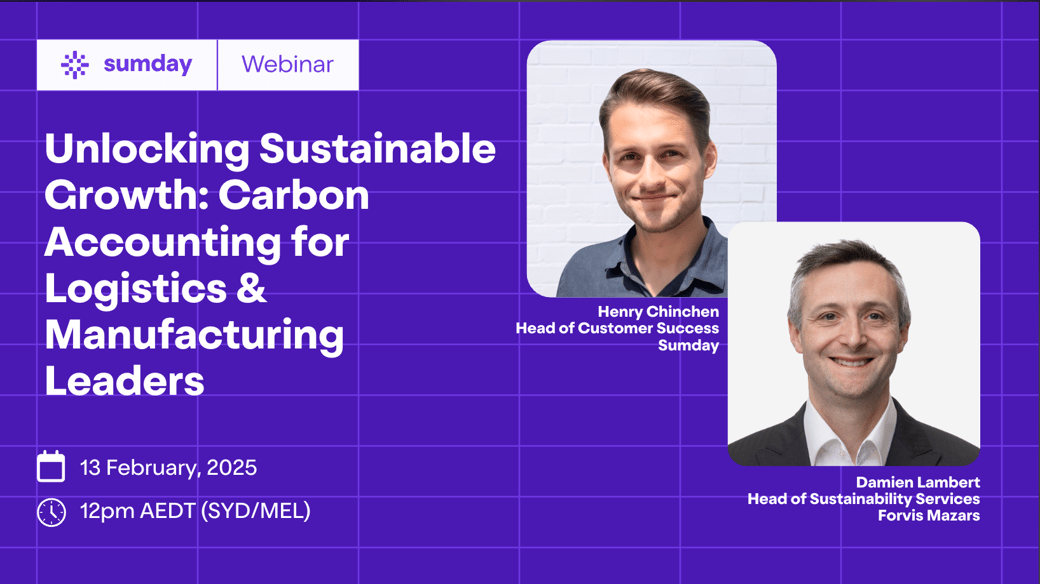
📺 Upcoming Webinar: Carbon Accounting for Logistics & Manufacturing Leaders
Join us on the 13th of February for an insightful logistics and manufacturing industry focused webinar with Damien Lambert, Head of Sustainability Services at Forvis Mazars Australia.
Whether you're facing growing demands for transparent reporting or simply exploring where to begin, this session will equip you with the tools and knowledge to drive sustainable growth in your organisation.
✈️ New Mini-Workpaper: Streamline Your Flight Emissions Calculations!
Exciting news from the Sumday team! Our first Mini-Workpaper is here to help you quickly and easily calculate flight distances in bulk across hundreds of transactions or itinerary lines.
With this tool, you'll get a summary of passenger kilometres by flight method, ready to enter straight into Sumday - saving you time and effort in your carbon accounting process.
Want to give it a try? Fill out this short form to get your copy ⬇️
Curious to see how it works? Watch this quick demo from the creator Toby!

🎓 Newest Article from Lindsay: Carbon Consolidation
As corporates mature in their carbon reporting , the process of consolidating GHG inventories from multiple entities into a group-level inventory is becoming an increasingly important topic.
Currently, many large organisations disclose only group-level emissions data - but what is the driver to move to entity-level reporting? What’s involved, and what’s often missed?
Carbon Consolidation in the Spotlight
🔖 Are You Starting on a Supply Chain Engagement Project?
Check out our latest 4 minute guide providing tips on how to engage suppliers on carbon accounting ⬇️
Tips on how to start engaging with your suppliers on Carbon Accounting.

🇦🇺 Australia Introduces $2B Green Aluminium Production Credit Scheme
The Australian government has announced a $2 billion Green Aluminium Production Credit, available from 2028–29, to help aluminium smelters transition to renewable electricity. Scope 2 emissions, which make up around 85% of aluminium smelting emissions, are a key focus of the initiative.
Smelters achieving significant decarbonisation progress by 2036 can negotiate emissions-linked credit contracts, receiving payments per tonne of green aluminium produced for up to 10 years.
Part of the Future Made in Australia plan, this credit aims to reduce industrial emissions, strengthen the green metals sector, and position Australian aluminium as a global leader in sustainability. source
✈️ Amex New Carbon Pricing Solution for Business Travel
American Express Global Business Travel (Amex GBT) has launched a new solution enabling businesses to apply an internal carbon price to their corporate travel and use the funds to support decarbonisation projects. The tool allows companies to pick a carbon calculation methodology (from IATA, ICAO, France’s ADEME, UK’s BEIS, US EPA), track their flight emissions, and add a visible carbon fee to invoices and booking systems. Amex added that aligning carbon pricing with the emissions specific to a traveler’s flights at point of sale can support employee engagement and incentivise more sustainable economic decisions. source
🇨🇳 Shanghai Stock Exchange Strengthens ESG Reporting with New Guidelines
The Shanghai Stock Exchange (SSE) has introduced updated sustainability disclosure guidelines to enhance ESG reporting practices among listed companies. The new guides focus on climate risks, carbon emissions, and sustainability governance. In 2024, 52% of SSE-listed companies disclosed ESG reports, a 6% increase year-on-year, with 1,193 companies participating. source
🇪🇺 EBA Launches ESG Guidelines Consultation to Assess Climate & Business Risks
The European Banking Authority (EBA) has opened a public consultation on proposed ESG guidelines designed to help financial institutions better assess climate-related and broader sustainability risks. The guidelines provide a framework for integrating ESG factors into scenario analysis and guide institutions in adopting forward-looking approaches that assess resilience against ESG risks. source